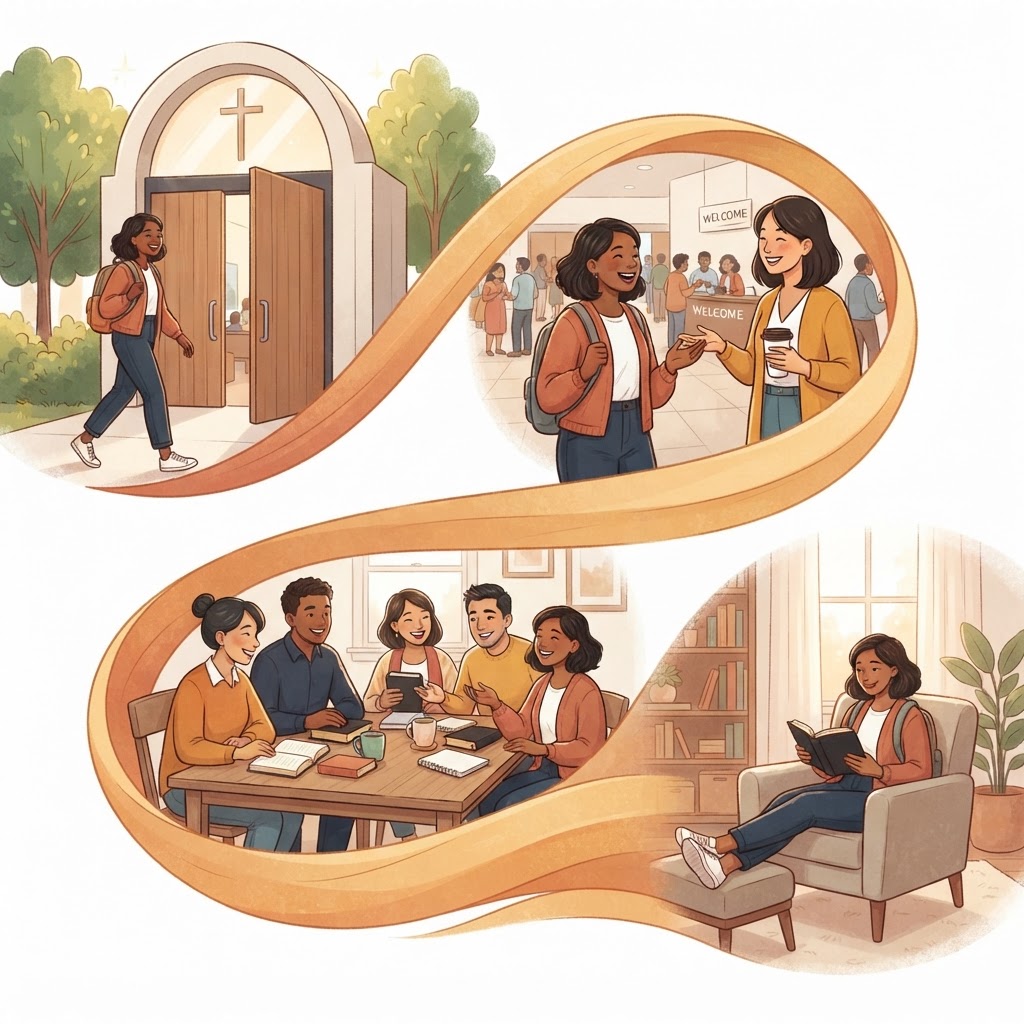
The Lifecycle of an Invitation: Turning Sunday Visitors into Committed Disciples
The Anatomy of a Welcome
Every Sunday morning, someone walks through the doors of your church carrying the weight of the week. They might be seeking peace, community, or perhaps just a place to exist without being noticed. As ministry leaders, we are often tempted to view this moment through the lens of attendance logs and digital metrics. While those numbers reflect a pulse, the heart of our mission is not to manage crowds but to shepherd souls. The transition from a Sunday visitor to a rooted disciple is one of the most sacred tasks we hold, yet it is often left to chance. If we want to see true spiritual growth, we must move beyond the hope of accidental connection and embrace the necessity of a structured lifecycle for every new person who walks through our doors.
We often think of hospitality as a personality trait, something that occurs naturally if our volunteers are warm enough. However, hospitality—when linked to discipleship—is actually a system. It is the intentional design of a pathway that moves someone from the isolation of being a spectator to the intimacy of being a contributing member of the Body of Christ. When we lack a clear trajectory, we inadvertently invite people to remain on the periphery, never tasting the depth of life that comes with full commitment to a local church family.
The Logistics of Belonging
To shepherd effectively, we must manage the logistics of integration with as much care as we do our Sunday liturgy. A system of integration is not about checking boxes; it is about ensuring that no one falls through the cracks of our good intentions. It begins with the 'First Five Minutes' philosophy. When a visitor arrives, do they have a clear sense of what happens next? If the church feels like an exclusive club with insider knowledge required to join, we have failed in our stewardship of the Gospel.
Mapping the Pathway
Consider the pathway as a series of intentional handoffs. Each step should be designed to lower the barrier of entry and increase the intimacy of the connection. Start by auditing your current process. What happens the moment a visitor leaves the sanctuary? Is there a designated space where they feel welcomed without being overwhelmed? A successful integration strategy includes:
- A dedicated connection point that offers a tangible next step, like a 'New Here' card or a digital link, rather than just a smile.
- A timely follow-up protocol that happens within 48 hours, emphasizing a personal note over a generic form email.
- An invitation to a 'Coffee with the Pastors' or a similar low-stakes environment that allows them to ask questions in a smaller, safer setting.
- A clear, written roadmap of small groups or service teams that outlines the 'why' behind each opportunity, not just the 'what'.
By defining these steps, you remove the guesswork for the visitor. You are essentially saying, 'We have prepared a place for you, and we are excited to help you find it.' This clarity is an act of love. It respects their time and their desire for genuine connection.
From Logistics to Life Change
Once the logistical pathway is laid, the real work of shepherding begins. Systems are only the scaffolding; the building itself is made of relationships. We move people from attendees to members by recognizing their specific gifts and calling them toward their unique contribution to the Kingdom. This is where mentorship plays a pivotal role. When a new person is paired with a mentor—someone who isn't a staff member but a mature, long-term congregant—the church ceases to be an institution and becomes a community.
Mentorship acts as the bridge between curriculum and daily living. It is one thing to study a discipleship book in a small group, but it is entirely another to see how that faith is applied in the messiness of a career, a marriage, or the struggles of singlehood. By integrating mentorship into your small group tracking, you ensure that no one is left to interpret their faith journey in a vacuum. Your small groups should be more than just Bible studies; they should be training grounds for mission, where leaders are constantly asking, 'How can we empower this person to serve in their unique sphere of influence?'
Cultivating a Culture of Invitation
True hospitality is contagious. When your congregation sees leadership prioritizing the new arrival, it shifts the entire ethos of the Sunday experience. Instead of the typical 'clique' behavior where members congregate with their closest friends, you can actively foster a 'third-space' environment. Consider implementing a '10-minute rule' for your members: encourage them to spend the first ten minutes after a service specifically engaging with someone they do not recognize. This small, cultural shift changes the landscape from a passive attendance model to an active missionary focus. We must train our people to be ambassadors of belonging. When a guest walks in, they shouldn't be greeted by a professional greeter alone, but by a congregation that understands their shared responsibility in the Great Commission. This requires regular teaching from the pulpit on the theology of hospitality—reminding the body that we were once strangers who were welcomed by the grace of God. By regularly highlighting stories of people who were brought into the family through simple acts of kindness, you reinforce that this is a collective identity, not just a staff function.
The Anatomy of a Success Story: A Worked Example
Imagine a guest named Sarah. She enters your sanctuary for the first time, feeling skeptical and invisible. Under a structured system, the process looks like this: First, our welcome team notices her posture and offers a warm, non-intrusive greeting. Second, she receives a physical 'Next Steps' card that explicitly tells her where the coffee and information kiosk are located. Third, by Tuesday, she receives a handwritten note from a staff member that mentions a specific detail she shared. Fourth, she is invited to a 'Growth Track' lunch where she meets others in her stage of life. Finally, after four weeks, she is invited to join a mid-week group led by a veteran congregant who acts as her mentor. Sarah moves from an observer to a participant because every step was designed to anticipate her needs before she even voiced them. This is not manipulation; it is removing the friction of entry to allow the Holy Spirit to work without the distraction of confusion or anxiety. By tracking this journey, you ensure no one is forgotten, and every person is given the opportunity to find their place at the table.
Essential Takeaways for Ministry Leaders
- Audit your signage and physical space to ensure a stranger can navigate your building without asking for help.
- Establish a 48-hour follow-up rule that prioritizes handwritten notes or personal phone calls over automated digital responses.
- Recruit and train 'Connection Mentors' who are specifically tasked with walking alongside new attendees for their first six weeks.
- Create a 'Menu of Service' that highlights low-commitment, entry-level volunteer roles to help new people feel useful quickly.
- Host a recurring, informal 'Pastor's Brunch' that serves as an open house for new families to learn the DNA of the church.
The Fruit of Consistency
Ultimately, the goal of this systemic approach is to produce disciples who do not rely on the staff to feed them, but who have learned how to feed themselves and others. When we treat the visitor experience as the first step in a lifelong journey of discipleship, we shift the culture of the church from one of consumption to one of multiplication. We stop asking 'How can we keep them coming?' and start asking 'How can we equip them to go?'
This shift requires humility from leadership. It means admitting that we cannot be everything to everyone. It requires delegating the work of integration to the entire congregation, equipping them to see every visitor as a potential brother or sister in Christ. When the system is strong enough to support the logistics, the church is free to focus on the spirit. The result is a vibrant, growing community where every member feels known, valued, and tasked with the beautiful, ongoing work of the Gospel.
May your heart be refreshed as you steward the people God brings to your doors, knowing that every small act of intentionality plants a seed for eternity. May you find great joy in watching those seeds grow into deep, abiding relationships within your church family. Until next time — keep walking the path. See you in the next post.